Cambodia Is Moving Up the Value Chain
Beyond garments, toward higher-value industries. What Korean companies should know about automotive parts, electronics, EV, healthcare and digital manufacturing in Cambodia.
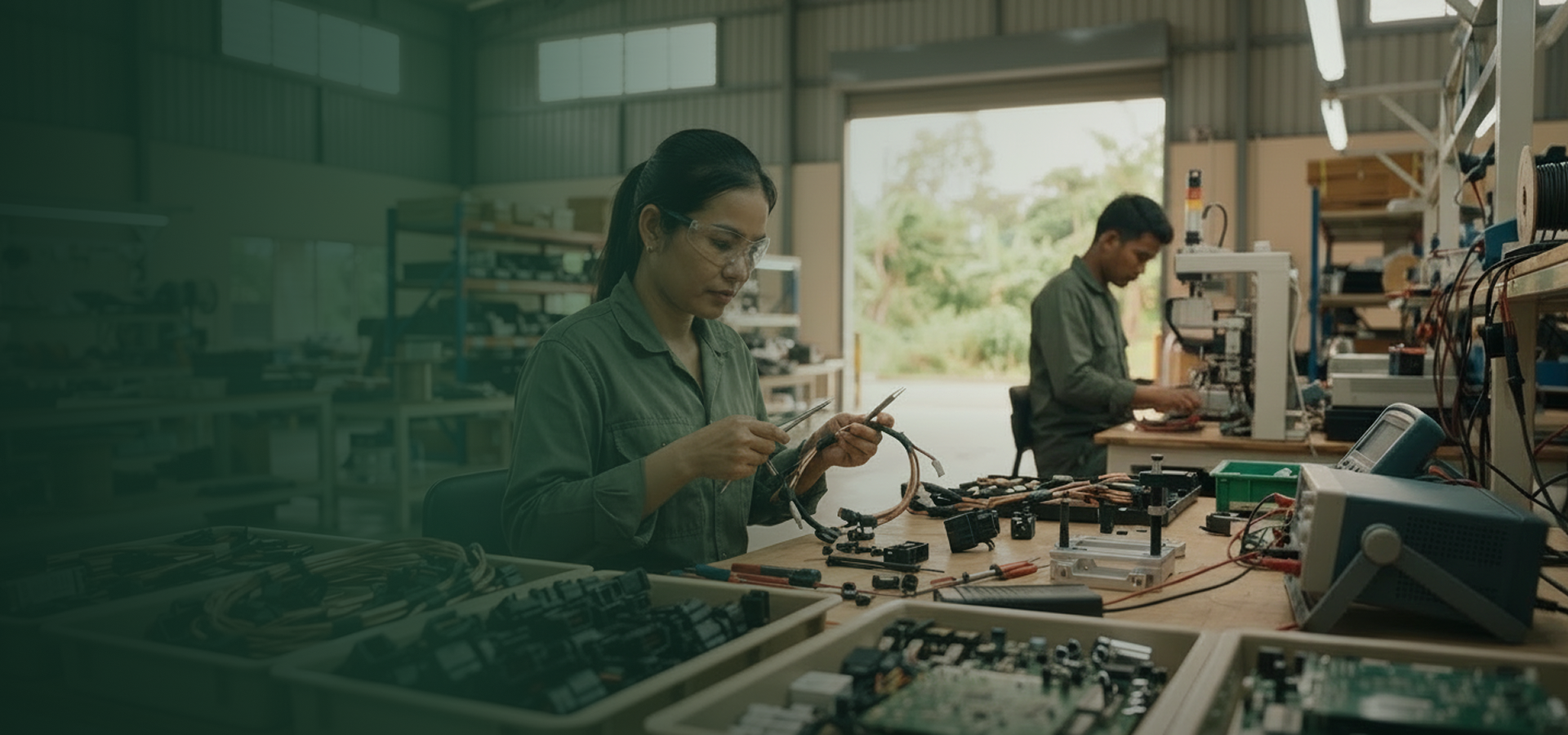
Cambodia is no longer defined by garments alone. The country's investment framework now covers a much broader group of activities — high-tech and high-value manufacturing, electrical and electronic industries, spare parts and assembly, machinery, digital industries, health, logistics, green technology, agro-processing, and industries connected to regional and global supply chains.
For Korean companies looking at Cambodia in 2026, the question is no longer simply whether Cambodia can host lower-cost manufacturing. It is whether the country can become part of a wider production, sourcing and regional expansion strategy.
A broader industrial direction
Cambodia's current investment framework explicitly identifies high-tech industries, high-value manufacturing, industries supplying regional and global production chains, electrical and electronic industries, spare parts and assembly, machinery, digital industries, health, logistics, green energy and technology, and agro-processing among activities eligible for investment incentives — subject to the applicable rules and project qualification.
For qualified investment projects (QIPs), the Council for the Development of Cambodia (CDC) sets out basic and additional incentives. Depending on the activity, these can include income-tax incentives, customs and tax exemptions for qualifying imported inputs, and additional incentives tied to training, R&D, technology and productivity.
This does not mean every project or sector receives the same treatment. Eligibility, incentive duration and conditions depend on the activity and the relevant legal framework. Companies should confirm current requirements with the CDC or qualified local advisers before making an investment decision.
Automotive and electronics are a visible part of the shift
Cambodia's automotive and electronics sector roadmap identifies local supplier ecosystems, investment incentives, trade facilitation and improved infrastructure as parts of its strategy for strengthening these sectors — and aims to increase exports and employment over a five-year horizon.
The focus isn't only on assembling products, but on developing suppliers and improving the wider production ecosystem. That distinction matters: a manufacturing project's long-term competitiveness depends on local suppliers, logistics, technical skills, utilities, industrial locations, and the ability to coordinate with public and private partners.
- 01AUTOMOTIVE
- 02ELECTRONICS
- 03EV / ELECTRICAL
- 04HEALTHCARE TECHNOLOGY
- 05DIGITAL
- 06GREEN TECHNOLOGY
Korean companies are already looking more closely
The interest is concrete. In July 2026, a delegation of 15 South Korean companies — spanning automotive, electronics, textiles, finance, construction, distribution and food — met Cambodian officials to discuss investment and expansion. Seven already operated in Cambodia; six, based in Vietnam, were weighing expanding manufacturing into Cambodia.
In automotive specifically, Korean supplier Yura Harness Cambodia — producing automotive wiring harnesses in the country since 2022 — discussed expanding its investment in May 2026.
These examples don't mean every Korean company should move production to Cambodia. They do show Cambodia is being considered within real Korean expansion discussions, particularly where manufacturing, supply chains and regional operations overlap.
What about EVs, healthcare and technology?
The opportunity isn't limited to conventional automotive manufacturing. The framework also covers electrical and electronic industries, digital industries, high-value manufacturing, health, and green energy and technology.
For companies in EV-related systems, electronics, healthcare technology or digital services, the relevant path may look different from a traditional factory — component production, assembly, regional supply, technology services, distribution, partnerships, or a combination.
The key is to test the opportunity against the actual market. Incentives can improve a project's economics, but they don't replace customer demand, supplier quality, workforce availability, logistics planning or reliable local relationships.
The real work starts before the investment
For a Korean company considering Cambodia, the hardest part may not be identifying a sector. It's turning a broad opportunity into a practical, evidence-based project.
- 01
Understand the market
identify demand, competitors, customers, pricing and the real size of the opportunity.
- 02
Map the local ecosystem
suppliers, distributors, service providers, industrial locations and relevant institutions.
- 03
Find and assess partners
compare on capability, track record, communication and fit — not introductions alone.
- 04
Check the operating reality
logistics, workforce, utilities, land or facilities, permits, and day-to-day coordination.
- 05
Build the project case
combine commercial findings, operating requirements and applicable incentives before committing capital.
Why local groundwork matters
A company can identify a promising sector from outside Cambodia in a matter of days. Understanding how that sector actually works on the ground usually takes longer.
Supplier conversations may need local-language support. A promising partner may need checking beyond its website. A site may look attractive on a map but have practical limits for workers, logistics or utilities. An incentive may exist, but the project still has to meet the conditions.
This is where structured local research and coordination help. The aim isn't to replace the client's commercial decision — it's to give the decision-maker better information before committing time and capital. For Korean companies, Cambodia can be worth investigating not simply as a lower-cost location, but as one possible part of a broader Southeast Asian production and market strategy.
Where YEON Global Support fits
- Market research
- Supplier and partner identification
- Local coordination
- Multilingual communication
- Administrative support
- Project coordination
Is Cambodia actually a fit for what you're trying to do?
YEON Global Support helps Korean and international businesses understand Cambodia's local business environment — market research, supplier and partner identification, local coordination, multilingual communication, and project support.
The first step doesn't have to be a large investment. It starts with a clear question. Tell us yours.
YEON · Korea × Cambodia Business Support · yeonglobalsupport.com
Frequently asked questions
Which industries does Cambodia offer investment incentives for?
The framework covers high-tech and high-value manufacturing, electrical and electronics, spare parts and assembly, machinery, digital, health, logistics, green technology, and agro-processing — subject to project qualification. Confirm current details with the CDC.
Are Korean companies really moving into Cambodia?
Yes — a 15-company Korean delegation met officials in July 2026, and suppliers like Yura Harness (in Cambodia since 2022) have discussed expanding. It's being considered case by case, not as a blanket move.
Do I need a big factory investment to start?
No. Depending on your sector, entry can involve component production, regional supply, technology services, distribution or partnerships. The first step is usually research, not capital.
Is this legal or tax advice?
No. This article is informational only. Investment incentives depend on applicable laws, activity categories and project conditions — confirm with the CDC or qualified local advisers.
Research. Compare. Coordinate. Decide.
- CDC — Incentives and Schemes — https://cdc.gov.kh/incentives-and-schemes/
- CDC — Law on Investment and Sub-Decree (English) — https://www.cdc.gov.kh/wp-content/uploads/2023/08/8823-LOI-and-Sub-Decree-ENG-Version.pdf
- CDC — Automotive & Electronics Sector Development Roadmap — https://file-pub.cdc.gov.kh/api/v2/asset/cdcIPM_web/files/ENG_Auto_%26_Electronics_Roadmap.pdf
- AKP — Korean Investors Eye Expanded Investment in Cambodia, 20 Jul 2026 — https://akp.gov.kh/post/detail/376138
- AKP — Yura Harness Plans Investment Expansion in Cambodia, 29 May 2026 — https://akp.gov.kh/post/detail/371604
- AKP — South Korean Firms Set Sights on Cambodia, 1 May 2026 — https://akp.gov.kh/post/detail/369221
Editorial note: This article distinguishes Cambodia’s investment-policy framework from individual project eligibility. Incentives are subject to applicable laws, activity categories and project conditions. Informational only — not legal, tax or investment advice.